Dristibhedah: The Language of Eyes in Bharatanatyam | Nrithya Digital gurukulam
Dristibhedah: The Language of Eyes in Bharatanatyam
“Where the hand goes, the eyes follow. Where the eyes go, the mind follows. Where the mind goes, bhava arises. Where there is bhava, rasa is born.”
In Bharatanatyam, the eyes do far more than look. They speak, suggest, question, invite, reject, remember, and reveal emotion before a single step is completed. This subtle science of eye movements is called Dristibhedah one of the most powerful aspects of abhinaya. If hasta mudras shape meaning and the body creates rhythm, it is often the eyes that bring life to the performance.
Types of Dristibhedah in Bharatanatyam
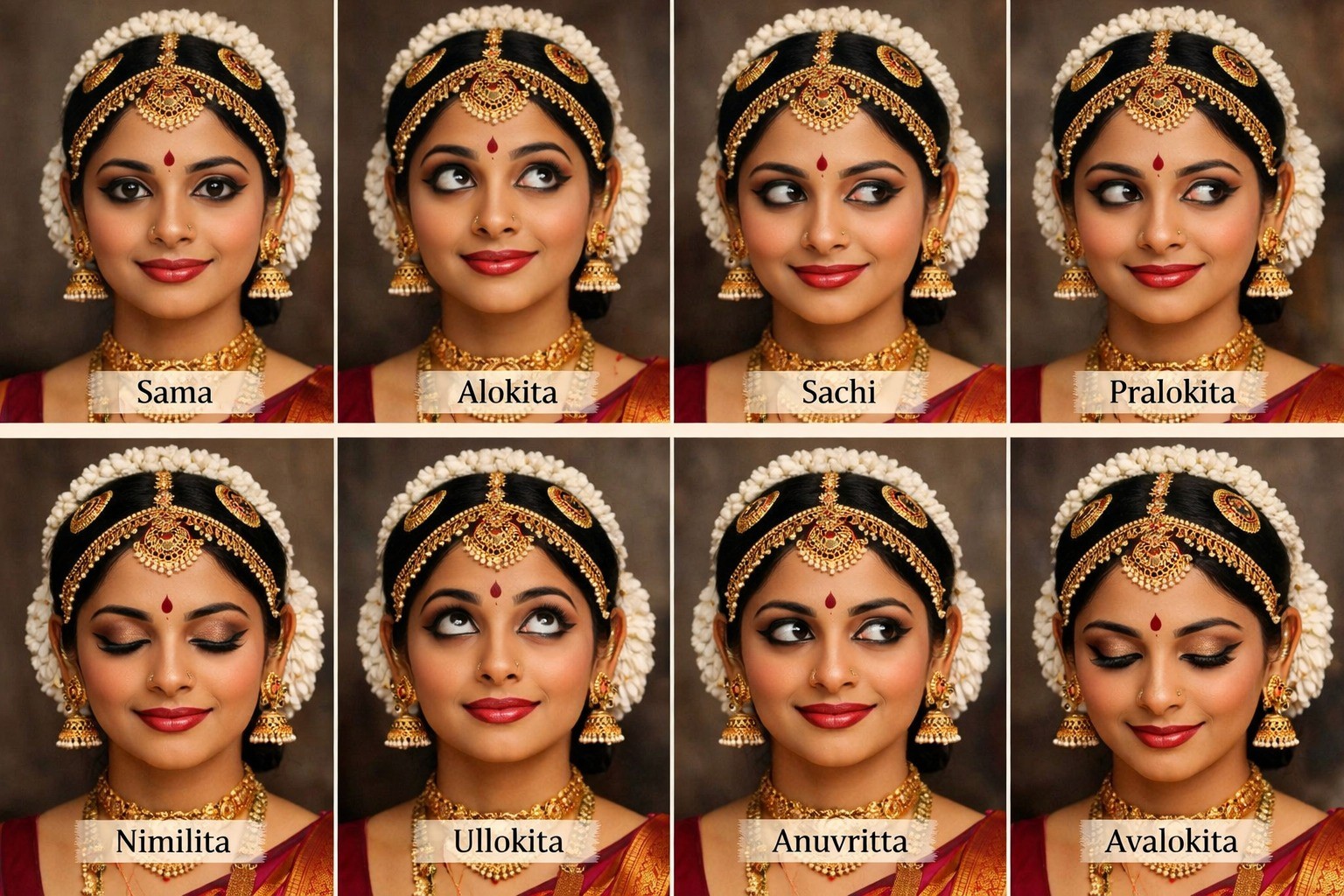
Dristibhedah means the classification of eye movements. In Bharatanatyam, it belongs to Angika Abhinaya, the expressive use of the body. The Abhinayadarpanam lists eight eye movements, each with a distinct form and purpose in performance.
1. Sama Drishti
Sama means level or straight gaze. The eyes remain steady and natural.
Used for: calmness, beginning of dance, divinity, composure, and attentive stillness.
This is often the base glance from which other expressions emerge. It creates dignity and control.
2. Alokita Drishti
Alokita is a fully opened, circular or scanning glance.
Used for: seeing all around, describing large objects, turning movement, or broad observation.
This glance is useful when portraying wonder, searching, or indicating something expansive.
3. Sachi Drishti
Sachi is the sidelong glance, where the eyes look from the corners.
Used for: suggestion, shyness, subtle communication, arrow-like focus, memory, and romantic expression.
This is one of the most charming and expressive glances in Bharatanatyam, especially in sringara.
4. Pralokita Drishti
Pralokita means looking from side to side.
Used for: observing both sides, movement, alertness, and emotional restlessness.
It helps when portraying searching, suspicion, or scanning a scene.
5. Nimilita Drishti
Nimilita is the half-closed gaze.
Used for: meditation, prayer, inner thought, salutation, and controlled inwardness.
This glance creates softness and spiritual depth.
6. Ullokita Drishti
Ullokita is the upward gaze.
Used for: looking at the sky, moon, tall objects, divine spaces, and ideas connected to height or heaven.
This is especially effective in devotional pieces and nature descriptions.
7. Anuvritta Drishti
Anuvritta is the quick up-and-down movement of the eyes.
Used for: anger, sharp reaction, excitement, and greeting friends.
It adds energy and immediacy to expression.
8. Avalokita Drishti
Avalokita is the downward glance.
Used for: looking at one’s body, shadow, reflection, fatigue, study, or anything placed below.
This gaze is often used in modesty, introspection, or describing objects near the feet.
Conclusion
Dristibhedah is the silent language of Bharatanatyam. It transforms movement into meaning and technique into rasa. When a dancer learns to control the eyes, the performance gains beauty, clarity, and emotional truth.
If you want to learn Bharatanatyam in a way that goes beyond steps and truly builds expression, join Nrithya Digital Gurukulam. Our structured online Bharatanatyam classes help students master adavus, mudras, abhinaya, and Dristibhedah with personal guidance and classical grounding.
Join Nrithya Digital Gurukulam today and let your eyes learn to speak the language of Bharatanatyam.